Industrial fan | Smart fan Overall solution service provider

Industrial fan | Smart fan Overall solution service provider


 13806436798
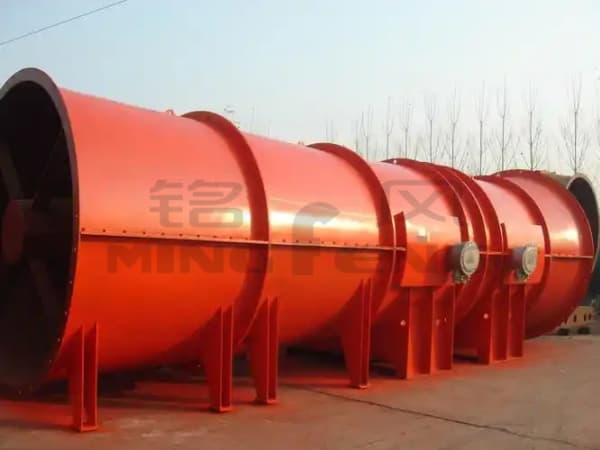
Tunnel fan is a specialized ventilation equipment used in underground engineering such as highways, railways, subways, water conservancy chambers, and mining tunnels to "exchange air, exhaust gas, and
01On site installation and debugging of equipment
02Regular follow-up visits
Tunnel fan is a specialized ventilation equipment used in underground engineering such as highways, railways, subways, water conservancy chambers, and mining tunnels to "exchange air, exhaust gas, and control smoke". The biggest difference between it and ordinary fans in factories is that the tunnel space is narrow, the resistance is special, traffic pollution sources continue to occur, and in the event of a fire, smoke or tobacco control must be carried out according to the plan. Therefore, fans often need to be resistant to high humidity, exhaust gas corrosion, remote group control, and partially reversible operation.
1、 Basic ventilation concept: Why do tunnels need dedicated fans
Tunnel ventilation is usually divided into two stages:
Ventilation during the construction period: fresh air should be supplied to the excavation surface, smoke and dust should be discharged, and diesel mechanical exhaust should be discharged. The commonly used flexible air duct is connected to the axial flow/cyclone press in, or a mixture of extraction and press in, with long single head excavation relying on relay.
Ventilation during operation: exhaust of CO, NOx, and smoke from vehicles on highways/urban roads; Railway exhaust from locomotives to ensure visibility; Brake dust and residual heat from subway trains; During a fire, smoke should be expelled in the correct direction to prevent backflow of smoke. The operation system can be divided into vertical, horizontal, semi horizontal, as well as vertical/inclined shaft segmentation, jet assistance and other combinations.
Tunnel fans are not enough to simply blow air, but are calculated systematically together with tunnel section, traffic flow, slope, altitude, vertical shaft, air duct, and traffic organization.
2、 Main types and working principles
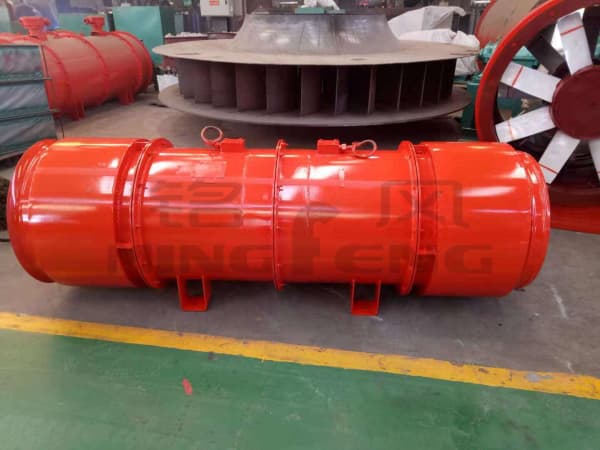
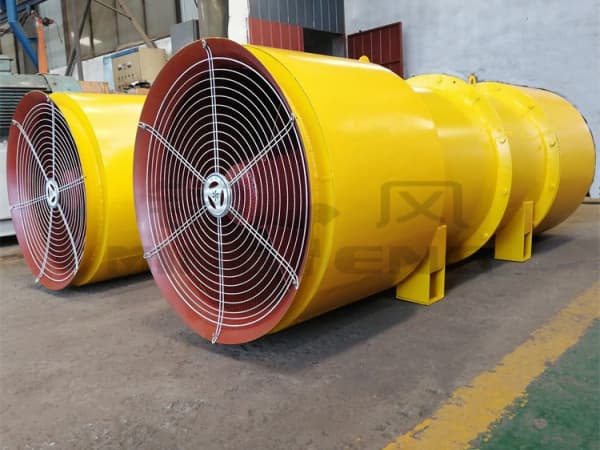
1. Jet Fan (commonly SDS type)
Essentially, it is an axial flow fan installed inside a tunnel, without air ducts, that directly sprays high-speed airflow into the tunnel.
Working process:
a. The motor drives the impeller to draw a portion of the tunnel air into the casing;
b. After the impeller accelerates, it is ejected from the outlet at a higher speed;
c. The high-speed jet exchanges momentum with the stationary/slow-moving air inside the tunnel, driving the entire tunnel section air forward;
d. After the speed decays along the tunnel, the next group of jet fans continues to "push".
So it doesn't rely on duct pressurization, but on "thrust" to push longitudinal airflow. Evaluation of common single thrust (N) and thrust power ratio in engineering: under the same power, the greater the thrust, the more energy-efficient it is.
Jet fans are commonly used for longitudinal ventilation in highway/urban road tunnels, and are hung on the arch or installed on the side walls/niches; Without building a separate main air duct, the civil construction cost is low, but noise, reverse control, and fire resistance need to be specially designed.
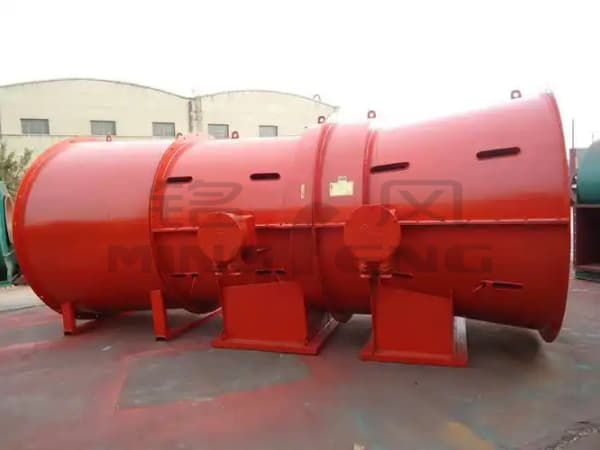
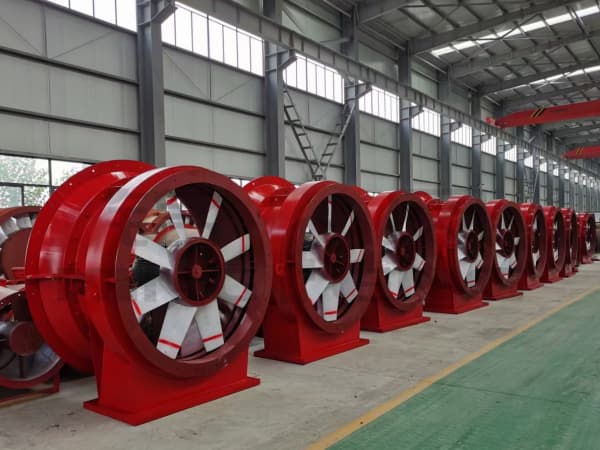
2. Axial flow/counter rotating main fan (SDF, SDF type counter rotating, external axial flow, etc.)
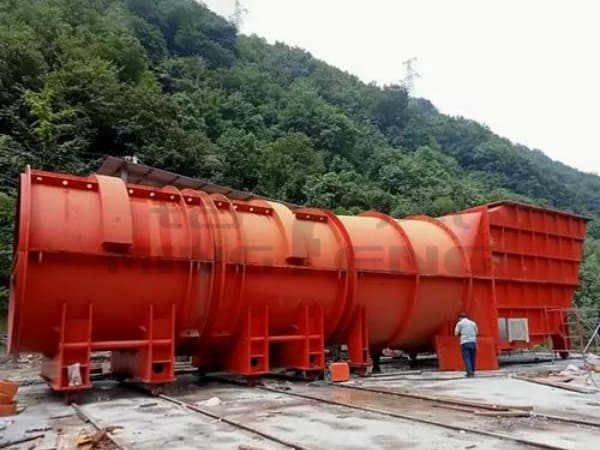
Used for systems that require centralized air supply and exhaust: vertical shaft air supply and exhaust, inclined shaft, entrance air duct, subway section smoke exhaust, and construction single head ventilation.
Single stage axial flow: Gas enters along the axial direction and is discharged after being pressurized by the blades, suitable for high air volume and medium to low air pressure;
Counter rotating axial flow: Two stage impellers rotate in opposite directions, with the first stage providing energy and the second stage accelerating and recovering some of the circulation. The wind pressure is higher and the adjustment range is wider. It is commonly used for long-distance construction and certain operational smoke exhaust;
Axial flow outside the tunnel+air duct/air duct: Fresh air is sent into the tunnel through the air duct, or polluted air is drawn to the ground for discharge, suitable for horizontal/semi horizontal ventilation and high environmental protection requirements in urban tunnels.
In railway regulations, axial flow fans should be selected based on air volume and pressure curves, with low air pressure and high air volume being the main factors. Consistency should be considered when multiple units are connected in parallel; The suction type requires the installation of a diffuser.
3. Divide by system combination
Pure jet longitudinal: it is most economical when short to medium tunnels and traffic piston wind can be utilized;
Main fan+jet assist: For long tunnels, the vertical shaft axial flow main fan bears most of the resistance, while the jet fan adjusts the wind speed and compensates locally;
Vertical/inclined shaft segmented axial flow: segmented ventilation for extra long highways and railway tunnels, facilitating smoke exhaust in fire zones;
Construction compression/extraction/mixing: compression type air duct is used to deliver to the palm surface, extraction type is used to extract sewage air, and the mixing type takes into account both long-distance and fast smoke exhaust.
3、 Typical structural composition
Speaking of jet fans and tunnel axial flow respectively:
Jet fan
Cylindrical casing: made of steel plate or anti-corrosion material, with built-in soundproofing layer;
Impeller: Aluminum alloy or steel airfoil blades for dynamic balancing;
Motor: usually built into the airflow or independent cooling chamber, the highway jet should be resistant to high temperature, moisture, and have a high level of protection;
Current collector/guide vane: the inlet collects current, and the outlet can be straightened with guide vanes to reduce eddy currents;
Muffler: inlet and outlet soundproof tubes filled with glass wool and perforated plates to control noise inside the hole;
Installation bracket/lifting device: pre embedded plate, steel bracket, anti loosening bolt, safety chain, capable of withstanding self weight+train wind/piston wind+earthquake;
Control components: soft start/frequency converter, positive and negative switching contacts, temperature/vibration sensors.
Tunnel axial flow/counter rotating main fan
Wind duct/casing, collector, first/second stage impeller, guide vanes, motor (single motor driven by counter rotation or dual motor drive), bearing box;
The construction fan is equipped with a flexible air duct joint, and the operation main fan is equipped with an air duct flange, diffuser, and muffler;
Adjustable blade models can change air volume and pressure by shutting down or adjusting blade angles online;
The large machine is equipped with a thin oil station, cooling system, vibration temperature measurement, and fire resistant high-temperature motor.
4、 Key performance parameters (must see for selection)
Airflow Q: Calculated based on tunnel volume, design wind speed, traffic volume, and CO/VI dilution requirements for operation; Construction is calculated based on explosive dosage, mileage, number of people, and diesel equipment. The commonly used method for estimating the required flow rate on highways is "tunnel cross-sectional area x design longitudinal wind speed".
Full pressure/static pressure Pt, Pst: jet is more focused on thrust; Check if the total pressure of the main fan can overcome the dynamic pressure of the air duct, shaft, dust collector, muffler, air valve, and outlet. The resistance of the pipeline network approximately varies with the square of the flow rate.
Thrust F: Jet fan core, unit N. Comparing different models depends on the "unit power thrust", not just the kilowatts.
Speed and regulation: Axial flow/counter rotating variable frequency, adjustable blade angle; Multiple jet units are grouped for start stop or frequency conversion. The similarity relationship approximates Q ∝ n, pressure ∝ n ², and power ∝ n ³, but in reality, the manufacturer's performance curve shall prevail.
Temperature resistance and fire protection: The temperature resistance level and time shall be determined according to the design specifications for fire conditions; Common manufacturers of highway jet streams provide reports of high temperature operation at 250-300 ℃/1h or similar. Subway/building smoke exhaust also has fire high temperature requirements, which are subject to project fire protection design and product fire resistance test reports.
Noise: Silencers are commonly installed for jet streams in highway tunnels, and noise from air ducts inside and on the ground is controlled in urban scenes. Acceptance shall be based on the design values; Part of the data uses around 85 dB (A) as the reference line inside the hole.
Protection and Insulation: Tunnels are damp and prone to tail gas corrosion. Motors commonly use IP55 and F/H insulation; Coastal, chemical, and subway industries select stainless steel, fiberglass, and anti-corrosion coatings according to their corrosion levels.
Reversibility: When a two-way traffic tunnel or fire requires reverse airflow, choose reversible jet/axial flow. The reverse airflow of a unidirectional jet is generally lower than the forward airflow; Reversible models require similar forward and reverse airflow, with specific ratios determined by standards and design.
Efficiency and Energy Efficiency: Urban/highway main fans focus on high-efficiency zones; Some local regulations require unidirectional axial flow efficiency to be ≥ 85%, bidirectional flow efficiency to be ≥ 75%, and energy efficiency level to be no less than level 1, but it cannot be applied to all tunnel projects.
5、 Selection and layout principles
1. Determine the ventilation method first
Short tunnel, high traffic volume, small slope, environmentally friendly, allows for vertical discharge of pure jet flow at the entrance.
Long tunnel, deeply buried, requiring zoning for smoke exhaust, strict ground noise/emission: vertical shaft+axial flow main fan, equipped with jet flow regulation.
Subway section: Choose axial flow smoke exhaust fan or jet/track heat exhaust combination according to smoke control design.
Construction alone: Select the opposite rotary axial flow and air duct according to the excavation distance, and connect or parallel relay for long distances.
2. Calculate air volume and then calculate resistance
The required air volume for operating highways can be calculated based on the design speed, traffic volume, allowable concentration of CO, and smoke visibility, and the maximum value of "traffic ventilation, personnel health, and fire smoke exhaust" can be taken; Calculate the frictional resistance along the way, as well as the total pressure of the inlet/outlet/shaft/air duct/silencer/damper. Construction shall be calculated based on the dilution of cannon smoke or diesel engine exhaust, the longest single head distance, and the air leakage rate within 100 meters of the air duct.
3. Layout of jet fan
The axis is parallel to the centerline of the tunnel, and the lifting of the arch crown does not violate the building limit; Railway scenes require the stacking of niches/openings, and it is not advisable to lift the arch.
Multiple models of the same cross-section, vertically grouped, with spacing calculated based on thrust attenuation and backflow; It is recommended that the net distance between adjacent jet fans on the same section should not be less than 1 times the diameter of the impeller.
Prioritize high thrust and high thrust power ratio; Frequency conversion grouping energy-saving, linked by CO/VI/vehicle flow.
Redundancy should be added to bends, variable cross-sections, and ramp connections. It is generally recommended to include a 10% -15% wind pressure margin for bends, but whether to recalculate based on specific resistance should be considered.
4. Main spindle flow/counter rotation arrangement
Suitable for high air volume and low air pressure (railway operation), vertical shaft air supply and exhaust can be medium high pressure;
The number of parallel connections should not be too many, the model performance should be consistent, and anti surge measures should be taken;
Variable frequency operation, separate verification of temperature resistance and forward/reverse direction for fire smoke exhaust;
Suction out type with diffuser, stable foundation, motor close to the load center to reduce starting pressure drop.
5. Special media
Explosion proof jet/axial flow is used in gas tunnels, with a high backup ratio (50% for railway jet and 100% for large axial flow, which can be started within 10 minutes); High corrosion stainless steel/FRP; Heat resistant steel and cooling bearings are used for high-temperature flue gas.
6、 Key points for installation and debugging
Jet lifting: pre embedded plate/chemical anchor bolt bearing capacity test, bracket hot-dip galvanized anti-corrosion, fan axis parallel to the tunnel line, without crossing the limit; The shell, muffler, and protective net are not loose; Grounding the main line of the tunnel.
Axial flow main fan: The foundation strength, anchor bolts, centerline, and air duct soft connections are supported separately without compressing the weight of the pipeline; The protective net and coupling guard are complete.
Electrical: The jet is often soft started or variable frequency, and the bidirectional model performs forward and reverse inching; Set overload, phase loss, temperature rise, and vibration protection according to the design; The grounding resistance shall be in accordance with the design and acceptance specifications (some highway construction materials require ≤ 1 Ω, and other scenarios shall be in accordance with the design).
Debugging: Single machine operation → Current/voltage/steering/vibration/noise → System joint test run → CO/VI or smoke linkage. According to the contract, the bidirectional jet has undergone multiple directional changes within the specified time without any abnormalities.
7、 Operation, maintenance and common faults
The general rhythm of ventilation in highway tunnels according to maintenance standards is that the jet should be regularly inspected for 1-3 months and regularly maintained for 1 year; Axial flow with the same frequency but with special features such as increased oil system, blade adjustment, vibration temperature, etc.
Daily/Regular Inspection
There is no abnormal noise or vibration; Is the current within the rated range;
Reverse function (bidirectional) regular testing;
Install bracket bolts, safety chains, anti-corrosion measures, and grounding;
Leaf dust accumulation/deformation, whether there are foreign objects in the protective net;
Motor temperature rise, insulation, and three-phase current balance.
Regular inspection and maintenance
Jet flow: clean blades, measure thrust/wind speed, tighten bolts, lubricate bearings, calibrate dynamic balance;
Axial flow: check lubricating oil/cooler, guide vane/rotor angle, impeller wear, reverse test, and monitoring linkage;
High dust/coastal areas shorten the inspection cycle, and ordinary roads can be fully inspected once every 1-2 years.
Common Faults
Low air volume: air leakage/blockage in the air duct, excessive jet spacing, wrong direction, low system resistance, dust accumulation on the blades, low output of the frequency converter;
High vibration: unbalanced dust accumulation on the impeller, bearing damage, loose support, failure of dynamic balance, and entering unstable working conditions;
High current/tripping: low resistance and high flow (especially in the forward direction/improper control of certain jet groups), low voltage, motor failure, mechanical jamming;
Sudden increase in noise: shedding of sound-absorbing cotton, blade collision with shell, loosening of flow guide components;
Post fire retest: The temperature resistance test report, insulation, bearings, and control circuits are all retested before being put into operation.
You can also contact us for more models and support customization

You only need one phone call
Leave the rest to us

The sales team will have a detailed discussion with you
Tell us your needs

Engineers based on your requirements
Provide a reasonable solution for the demand

We will do it within a reasonable time frame
Complete with quality and quantity assurance

Installation team on-site installation
Debugging until stable production

Any problems in the later stage are welcome
Contact the after-sales engineer
You can also contact us for more models and support customization
You only need one phone call. Leave the rest to us
The sales team will have a detailed discussion with you and tell us your needs
Engineers provide reasonable solutions based on your needs
We will complete it with high quality and quantity within a reasonable time
Installation team on-site installation, debugging until stable production
If there are any problems in the later stage, you can contact the after-sales engineer
 13806436798
Mobile